
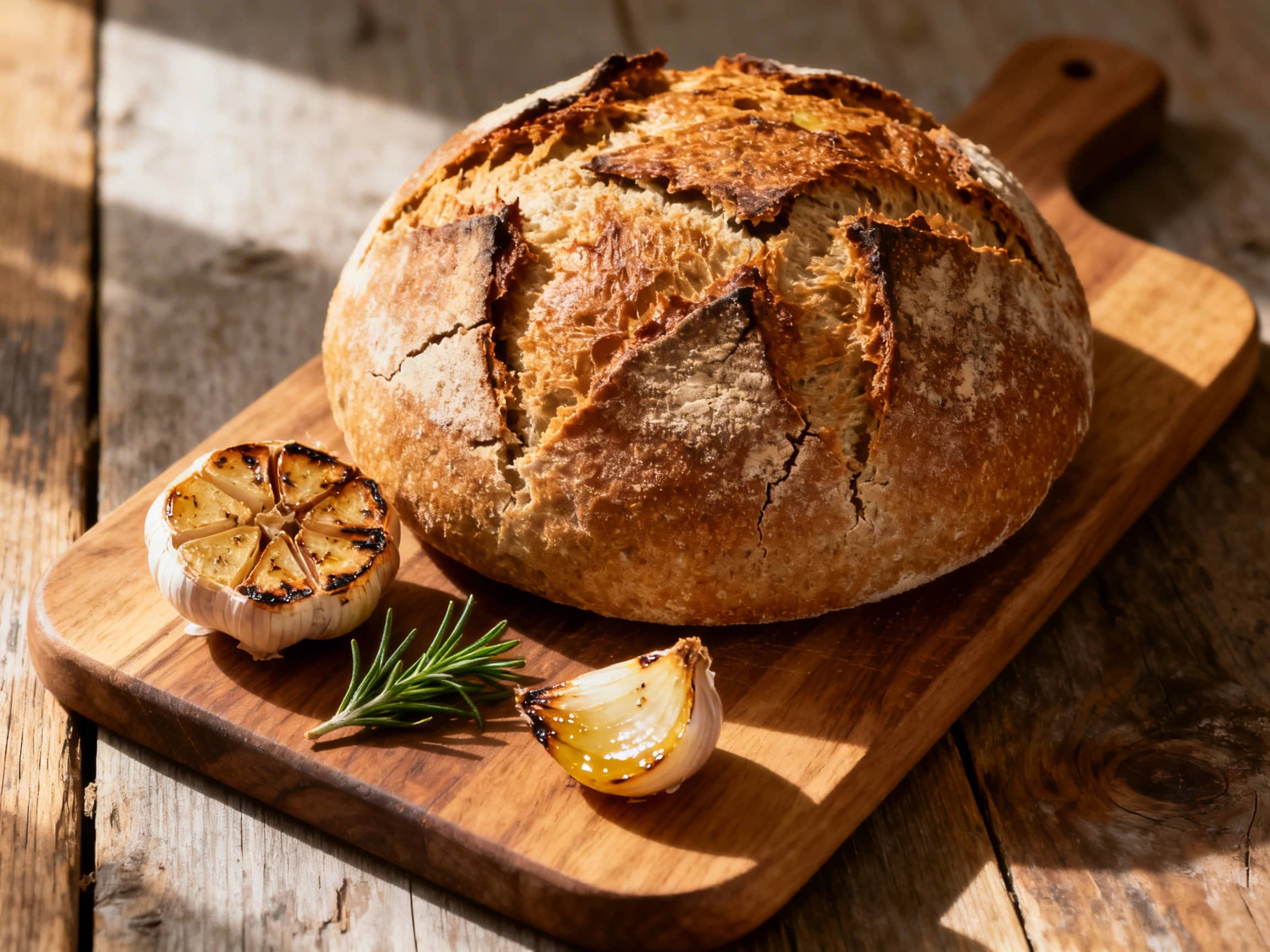
Whole Wheat Sourdough Boule with Roasted Garlic
Whole Wheat Sourdough Boule with Roasted Garlic
Embark on a culinary journey into the world of artisanal baking with this exquisite Whole Wheat Sourdough Boule infused with the irresistible aroma and flavor of roasted garlic. This recipe celebrates the time-honored tradition of slow fermentation, a hallmark of true artisanal breads, allowing complex flavors to deepen and textures to develop naturally. The inclusion of whole wheat flour adds an earthy depth and nutritional value, complementing the tangy notes characteristic of sourdough. Hailing from a rich European baking heritage, where naturally leavened breads have been a staple for centuries, this boule offers a perfectly crisp, crackled crust that gives way to a soft, open crumb studded with sweet, caramelized roasted garlic cloves. Each slice delivers a delightful balance of rustic sourdough tang and savory garlic, making it an extraordinary accompaniment to any meal, from a simple charcuterie board to a sophisticated dinner party. Master the art of this yeast bread, and you'll uncover the rewarding satisfaction of baking a truly memorable loaf that far surpasses anything you can buy.
- Preparation time
- 30 min
- Cooking time
- 40 min
- Total time
- 2 hrs 24 min
- Servings
- 2
Instructions
Preparing the Dough
- 1Combine the active sourdough starter and warm water in a large mixing bowl. Stir until the starter is mostly dissolved.
- 2Add the bread flour, whole wheat flour, and fine sea salt to the bowl. Mix with a spoon or your hands until a shaggy dough forms and no dry spots remain. Cover the bowl and let it rest for 30 minutes (autolyse).
- 3After the rest, perform your first set of stretches and folds. Gently stretch a portion of the dough up and fold it over itself. Rotate the bowl and repeat this 3-4 more times until the dough starts to develop strength. Cover and rest for 30 minutes.
- 4Distribute the mashed roasted garlic evenly over the dough. Perform another set of stretches and folds, ensuring the garlic is incorporated well. Cover and rest for 30 minutes.
Bulk Fermentation and Shaping
- 1Over the next 2-3 hours, perform 3-4 more sets of stretches and folds every 30-45 minutes. The dough should become noticeably smoother, stronger, and more elastic. Cover the bowl and let the dough continue bulk fermenting at room temperature until it has increased in volume by about 20-30% and is visibly bubbly (this can take 4-8 hours depending on room temperature and starter activity).
- 2Gently turn the dough out onto a lightly floured surface. Divide it into two equal portions if making two boules, or proceed with one for a larger loaf. Gently pre-shape the dough into a round or oval, being careful not to degas it too much. Let it rest for 20-30 minutes, uncovered, to relax the gluten.
- 3Flour your banneton or a bowl lined with a floured cloth. Perform the final shaping: gently stretch the edges of the dough, fold them towards the center, then flip the dough seam-side up and create tension on the surface by rotating it. Place the shaped dough seam-side up into the prepared banneton.
- 4Cover the banneton with a plastic bag or plastic wrap and refrigerate for 12-18 hours (cold proofing). This develops flavor and makes the dough easier to handle.
Baking
- 1Preheat your oven to 475°F (245°C) with a Dutch oven inside for at least 45 minutes to an hour. The Dutch oven must be very hot.
- 2Carefully remove the hot Dutch oven from the oven. Gently invert the cold dough from the banneton into the hot Dutch oven. Score the top of the dough with a sharp razor blade or knife to allow for even expansion during baking.
- 3Cover the Dutch oven and bake for 20 minutes with the lid on. This traps steam and creates a beautiful crust.
- 4Remove the lid and continue baking for another 20-25 minutes, or until the crust is deeply golden brown and the internal temperature reaches 200-210°F (93-99°C). If you desire a darker crust, you can reduce the oven temperature slightly and bake for an additional 5-10 minutes.
- 5Carefully remove the bread from the Dutch oven and place it on a wire rack to cool completely for at least 1-2 hours before slicing. This allows the internal structure to set and prevents a gummy texture.
Nutrition Information
- Calories
- 1200 kcal
- Protein
- 40 g
- Fat
- 25 g
- Carbs
- 200 g
| Nutrient | Per serving |
|---|---|
| Calories | 1200 kcal |
| Protein | 40 g |
| Fat | 25 g |
| Carbs | 200 g |
Tips
- Ensure your sourdough starter is active and bubbly, floating in water, before mixing the dough for optimal rise.
- Don't rush the bulk fermentation or cold proofing; these long processes are key to developing the sourdough's complex flavor and texture.
- Allow the boule to cool completely. Slicing too early can result in a gummy texture and impact the overall quality of the crumb.