
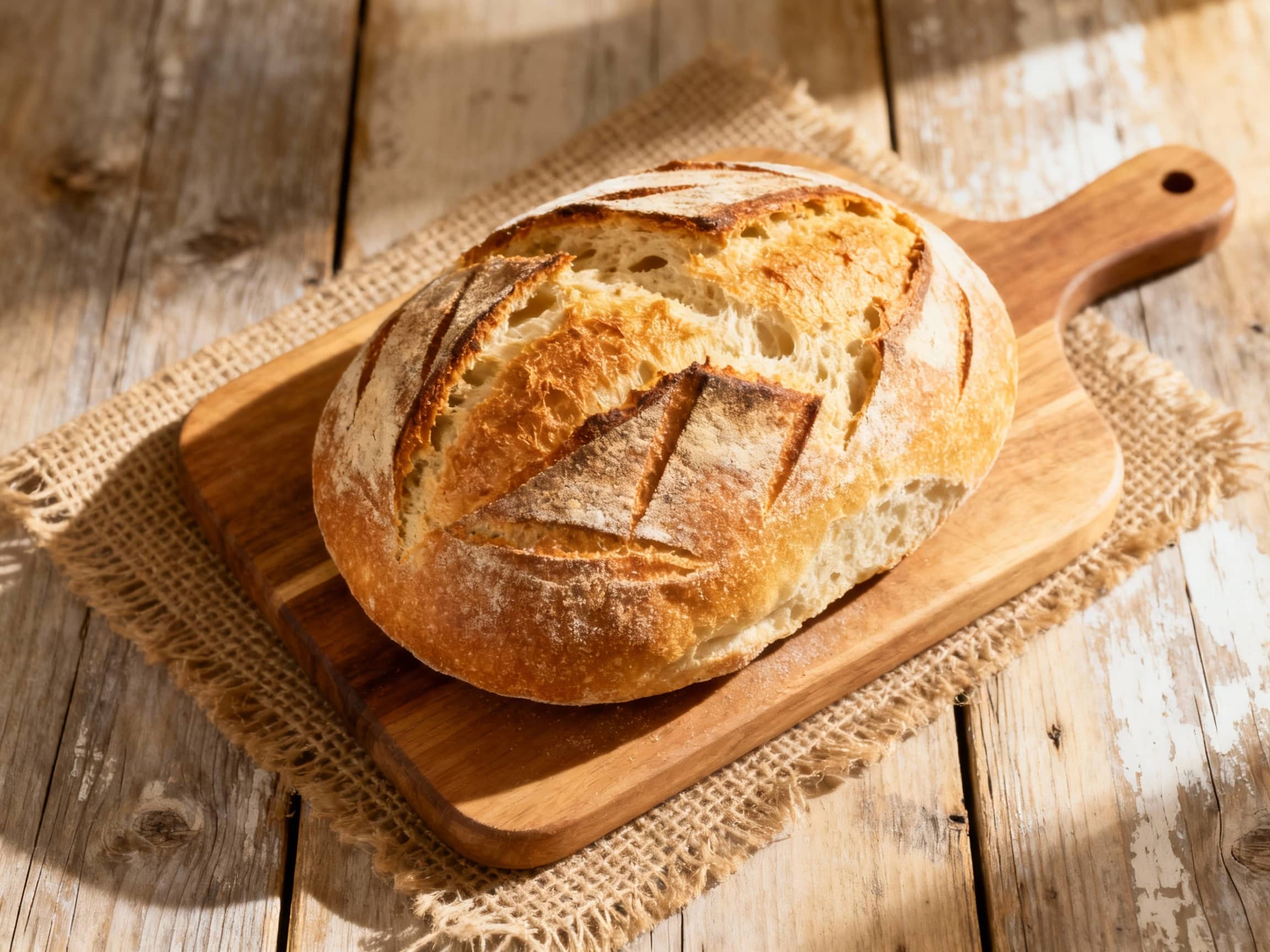
Rustic Sourdough Pan de Campagne
Rustic Sourdough Pan de Campagne
Bake a magnificent Rustic Sourdough Pan de Campagne, a classic French country bread renowned for its deeply satisfying flavor and chewy interior. This artisanal loaf boasts a crisp, gorgeously crackled crust that encases a tender crumb, characterized by the distinct tang of a well-nourished sourdough starter. It's a rewarding project for any baker keen to hone their craft in naturally leavened breads, offering a visually appealing and incredibly delicious result that perfectly embodies traditional baking. Enjoy the rich aromas filling your kitchen and the unparalleled taste of homemade sourdough, perfect for any meal or on its own.
- Preparation time
- 30 min
- Cooking time
- 45 min
- Total time
- 2 hrs 12 min
- Servings
- 1
Instructions
Mixing and Bulk Fermentation
- 1In a large mixing bowl, combine the active sourdough starter with 10 1/7 fl oz of water. Stir gently until the starter is mostly dissolved.
- 2Add the bread flour and whole wheat flour to the bowl. Mix with your hands or a Danish dough whisk until no dry spots remain and a shaggy dough forms. Cover the bowl and let rest for 30 minutes (autolyse).
- 3After the autolyse, sprinkle the salt over the dough. Incorporate the salt by gently folding and squeezing the dough in the bowl for 2-3 minutes. The dough will become more cohesive.
- 4Perform 4 sets of stretch and folds over the next 2 hours, with 30 minutes rest between each set. To do this, simply grab a portion of the dough, stretch it upwards, and fold it over onto itself. Rotate the bowl and repeat until you've gone all the way around.
- 5After the final stretch and fold, cover the bowl and allow the dough to bulk ferment at room temperature for an additional 2-4 hours, or until it has increased in volume by about 30-50% and feels airy.
Shaping and Cold Proofing
- 1Gently turn the dough out onto a lightly floured surface. Divide the dough into two equal portions if making two smaller loaves, or leave as one if making a large one. Gently preshape each portion into a loose round and let rest, covered, for 20-30 minutes.
- 2Lightly flour a banneton or a bowl lined with a floured towel. Tightly shape the dough into a boule or batard, building tension on the surface. Place the shaped dough seam-side up into the prepared banneton.
- 3Cover the banneton with plastic wrap or a shower cap and refrigerate for 12-18 hours for the cold proof. This develops flavor and makes the dough easier to handle.
Baking
- 1Preheat your oven to 230°C (450°F) with a Dutch oven inside for at least 45-60 minutes. The Dutch oven must be very hot.
- 2Carefully remove the hot Dutch oven from the oven. Gently invert the cold dough from the banneton directly into the hot Dutch oven. Score the top of the dough with a sharp knife or razor blade (lame).
- 3Cover the Dutch oven and bake for 20 minutes with the lid on. This creates steam for a great crust.
- 4Remove the lid and reduce the oven temperature to 220°C (425°F). Continue baking for another 25-30 minutes, or until the crust is deeply golden brown and the internal temperature reaches 96-99°C (205-210°F).
- 5Carefully remove the loaf from the Dutch oven and transfer it to a wire rack to cool completely for at least 1-2 hours before slicing. This is crucial for the crumb to set.
Nutrition Information
- Calories
- 2100 kcal
- Protein
- 75 g
- Fat
- 15 g
- Carbs
- 415 g
| Nutrient | Per serving |
|---|---|
| Calories | 2100 kcal |
| Protein | 75 g |
| Fat | 15 g |
| Carbs | 415 g |
Tips
- Ensure your sourdough starter is very active and bubbly before starting, it should float in water (the 'float test').
- For a thin, extra-crispy crust, keep the lid on for the first part of baking to maximize steam. A golden brown crust indicates optimal flavor.
- Allow the bread to cool completely before slicing to ensure the crumb fully sets and prevents a gummy texture profile.